
What it is
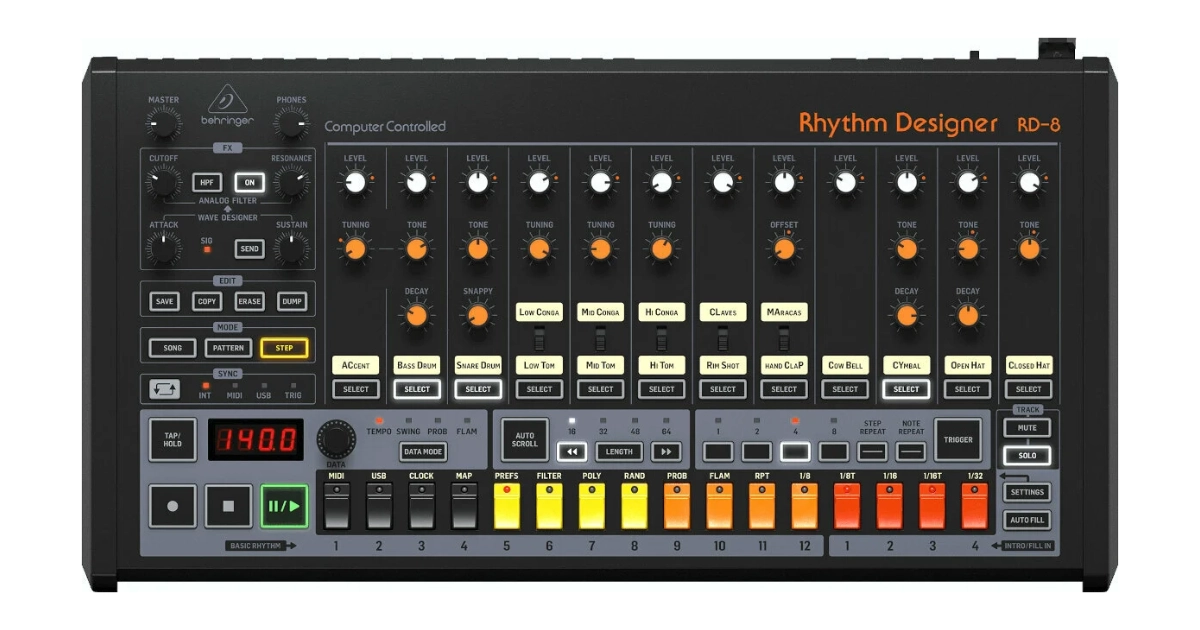
The Behringer RD-8 Rhythm Designer is an analog recreation of the Roland TR-808, built from genuine transistor-based analog circuits rather than digital or ACB (Analog Circuit Behavior) modeling. Behringer unveiled the RD-8 at Superbooth Berlin in May 2018; units reached customers through late 2018 and into early 2019.
The RD-8 replicates all 16 instrument voices of the original TR-808: Bass Drum, Snare Drum, three tom/conga selector pairs (Low Tom/Low Conga, Mid Tom/Mid Conga, Hi Tom/Hi Conga), Rim Shot/Claves, Hand Clap/Maracas, Cowbell, Cymbal, Open Hi-Hat, and Closed Hi-Hat. Each instrument group has its own dedicated analog synthesis circuit. Behringer added individual voice outputs, full DIN MIDI (IN/OUT/THRU), and USB MIDI, none of which existed on the original 1980 hardware.
Specifications sourced from the Behringer RD-8 product page and owner's manual. Superbooth 2018 announcement date sourced from contemporary gear press (Synthtopia, CDM). Last verified: 2026-09-04.
Specs that matter
The RD-8 houses 16 analog instrument voices across 11 instrument-group positions (matching the original TR-808 panel layout). The 16-step sequencer supports pattern chaining and Behringer documents 16 patterns in sequential memory.
Connectivity: 11 individual 1/4-inch mono outputs (one per instrument group), confirmed from the RD-8 product page and manual. Connecting a cable to any individual output automatically removes that voice from the main mono mix, which is useful for external effects or multi-track recording. A mono mix output and a headphone output round out the audio connections. MIDI runs over full DIN 5-pin IN/OUT/THRU and USB type-B (MIDI data only; no USB audio). Power requires a 12V DC wall adapter (included); there is no battery option.
What's in the box
- RD-8 Rhythm Designer unit
- 12V DC power supply
- Owner's Manual
The original TR-808 and Behringer's analog recreation approach
The Roland TR-808 (1980) was discontinued in 1983 after approximately 12,000 units. Its purely electronic drum sounds were initially dismissed as inferior to acoustic recordings, but by the mid-1980s the 808 had become foundational to Chicago house and Detroit techno. By the 1990s it was inescapable in hip-hop; the 2010s trap era made its kick drum ubiquitous across mainstream pop. Original units that once sold for as little as $100 on the used market climbed to several thousand dollars.
Roland responded with the TR-08 Boutique in 2017, using proprietary Analog Circuit Behavior (ACB) technology: component-level digital modeling of the original analog circuits. Behringer took a different approach with the RD-8, replicating the TR-808 circuit topology using modern analog components directly rather than modeling the behavior in software. The underlying TR-808 circuit designs have been in the public domain for decades.
The RD-8 differs from the original TR-808 in practical connectivity: it adds individual outputs for all 11 instrument groups (the original had only limited individual outs for select voices), full DIN MIDI (the original had DIN sync but no MIDI), and USB MIDI. The original's physical knob-per-voice panel layout and step-button interface are retained.
Note: Claims about the specific transistor types used in the RD-8 bass drum circuit, and their sonic relationship to the original TR-808's transistors, should be verified against Behringer's technical documentation if direct circuit comparison is a research priority.
Sources
- Behringer RD-8 product page -- specifications, connectivity, individual outputs (URL confirmed 2026-09-04)
- Roland TR-808 -- Wikipedia -- production history, discontinuation, cultural legacy
- Behringer RD-8 owner's manual -- MIDI implementation chart, individual output routing (available from Behringer support pages)
- Superbooth Berlin 2018 coverage -- Synthtopia and CDM archives confirm May 2018 announcement
Metrics
| Sequencer Steps | 16 |
|---|---|
| Instrument Voices | 16 |
Descriptors
| Brand | Behringer |
|---|---|
| Sound Engine | Analog synthesis |
| Form Factor | Desktop drum machine |
| Power Source | 12V DC wall adapter (included); no battery |
| Release Date | 2019 |
Instrument voices
The RD-8 replicates the complete TR-808 voice set using genuine analog circuits. Several buttons select an alternate voice on a second press (tom/conga, rim/claves, clap/maracas pairs).
| Voice | Family | Tags | Alternate Voice | Name | MIDI Note |
|---|---|---|---|---|---|
| BD | Kick | boom; analog-kick | Bass Drum | 36 | |
| SD | Snare | snap; crack | Snare Drum | 38 | |
| LT | Tom | tom; tuned | LC (Low Conga) | Low Tom | 43 |
| MT | Tom | tom; tuned | MC (Mid Conga) | Mid Tom | 47 |
| HT | Tom | tom; tuned | HC (Hi Conga) | Hi Tom | 50 |
| HC | Conga | conga; latin | Shared selector with HT | Hi Conga | 62 |
| RS | Percussion | click; rim | CL (Claves) | Rim Shot | 37 |
| CP | Percussion | clap; slap | MA (Maracas) | Hand Clap | 39 |
| CB | Percussion | cowbell; accent | Cowbell | 56 | |
| CY | Cymbal | sizzle; crash | Cymbal | 49 | |
| OH | Hi-Hat | open-hat; roll | Open Hi-Hat | 46 | |
| CH | Hi-Hat | closed-hat; 16ths | Closed Hi-Hat | 42 |
Frequently asked questions
Is the Behringer RD-8 a digital clone or a genuine analog instrument?
The RD-8 uses genuine analog transistor circuits to recreate the TR-808 voice architecture. It is not a digital model or sample playback device. Behringer designed the circuit board around the original TR-808 schematic, using modern analog components in the same circuit topology as the 1980 hardware.
How does the RD-8 differ from the Roland TR-08?
The Roland TR-08 (2017) uses Roland's Analog Circuit Behavior (ACB) technology: a digital component-level model of the TR-808 circuits running on a DSP. The Behringer RD-8 uses actual analog transistor circuits designed to replicate the same schematic through hardware. The RD-8 also provides 11 individual 1/4-inch physical outputs; the TR-08 uses USB audio channels for per-voice routing rather than dedicated jacks.
Does the Behringer RD-8 have individual outputs for each instrument?
Yes. The RD-8 provides 11 individual mono 1/4-inch outputs, one per instrument group position (matching the TR-808 panel layout). Connecting a cable to any individual output automatically removes that voice from the main mono mix. A separate mono mix output and headphone output are also provided.
Can the RD-8 run on batteries?
No. The RD-8 requires a 12V DC wall adapter (included). There is no battery option.
Does the RD-8 have USB audio for direct DAW recording?
No. The RD-8 provides USB MIDI only, not USB audio. To record individual voices into a DAW, use the 11 physical individual outputs with an audio interface.
When did Behringer announce the RD-8?
Behringer showed the RD-8 at Superbooth Berlin in May 2018. Units reached customers through late 2018 and into early 2019.
What MIDI connections does the RD-8 have?
The RD-8 provides full DIN 5-pin MIDI IN, OUT, and THRU jacks, plus a USB type-B port for USB MIDI (MIDI data only, not audio).
Is the RD-8 the same circuit as the original Roland TR-808?
Behringer describes the RD-8 as using the same analog circuit topology as the TR-808 with modern analog components substituted for the original 1980s parts. Whether specific transistors in the bass drum circuit match the behavior of the original is a question that Behringer has addressed in promotional materials but which engineers and producers continue to debate.
Related in this catalog
-
Roland TR-08 Rhythm Composer
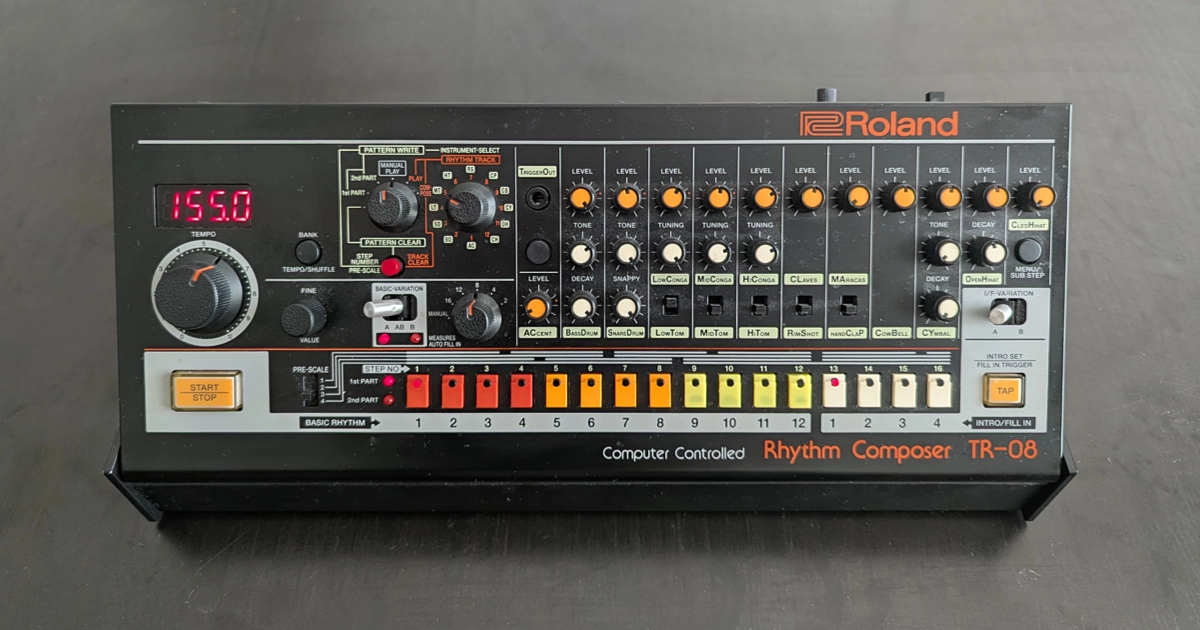
The Roland TR-08 is a compact Boutique-series recreation of the classic TR-808 Rhythm Composer: Analog Circuit Behavior modeling, a 16-step sequencer with sub-steps, USB audio/MIDI, and the familiar 808 voice set in a battery-powered metal-panel module.
-
Roland TR-8S Rhythm Performer
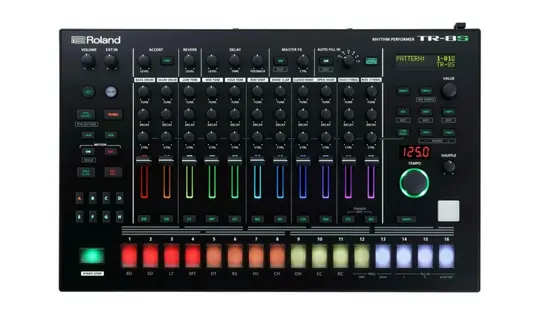
The Roland TR-8S combines Analog Circuit Behavior (ACB) drum modeling with per-track sample loading, letting producers assign built-in TR-808 or TR-909 ACB voices, other ACB instruments, or custom WAV files to any of its 11 configurable instrument tracks.
-
Arturia DrumBrute Impact
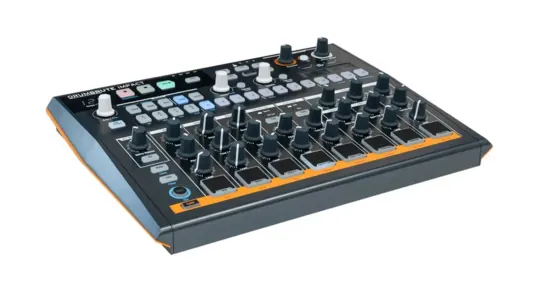
The Arturia DrumBrute Impact is a fully analog 10-voice drum machine with a 16-step sequencer, analog clock sync I/O, DIN MIDI IN/OUT, and USB MIDI. Every sound is generated by dedicated analog circuits with no samples or digital processing in the signal path.
-
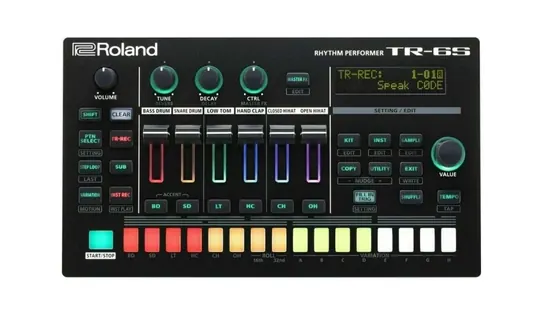
Roland TR-6S Rhythm Performer
The Roland TR-6S is a compact, battery-powered drum machine combining ACB instrument modeling with per-track sample loading across 6 configurable tracks. It runs on four AA batteries or USB bus power and includes standard DIN MIDI IN and OUT.