
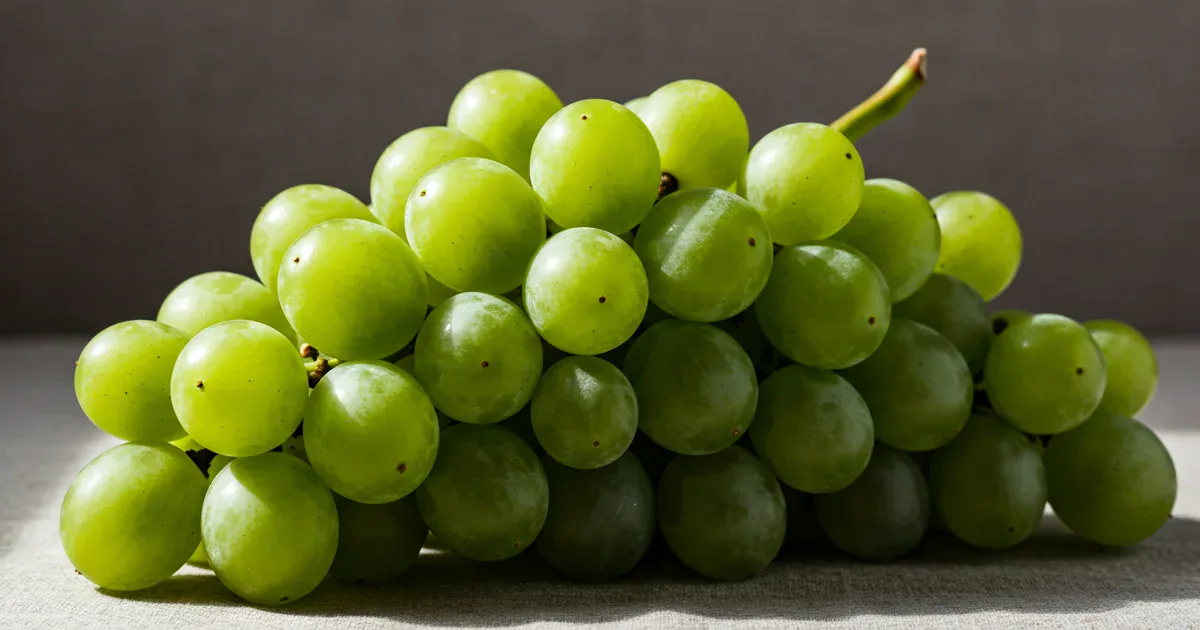
Origin & History
Sauvignon Blanc originated in the Loire Valley of France; its earliest reliably documented records are from the 18th century in the Touraine (Robinson, Harding & Vouillamoz, Wine Grapes, 2012, ISBN 978-1-846-14446-2). DNA analysis by Bowers and Meredith (1997, Nature Genetics, 16:84-87, doi:10.1038/ng0597-84) confirmed that Sauvignon Blanc is one parent of Cabernet Sauvignon, the other being Cabernet Franc, establishing it as a foundational French variety with global reach. Its own parentage within the Savagnin (Traminer) family has been proposed but not confirmed by published DNA data to the standard of the 1997 study; treat as uncertain. Registered in the OIV VIVC (Wikidata: Q271).
Viticultural Characteristics
Sauvignon Blanc grows best in cool to moderate climates where its naturally high acidity can be expressed. In too-warm conditions or if over-ripened, the distinctive grassy-herbal volatile thiols (the compounds responsible for grapefruit, passionfruit, and blackcurrant-leaf aromas) fall away and the variety becomes generic. Marlborough's Wairau Valley alluvial soils, combined with cool Pacific nights, produce the thiol-intense profile that reshaped the variety's global image from the 1980s. Loire Valley flint and chalk soils in Sancerre and Pouilly-Fume add a mineral dimension.
Winemaking Style
Overwhelmingly unoaked and intended for early drinking; barrel fermentation (as practiced in Pessac-Leognan) adds weight and longevity but mutes the varietal thiol signature. Fermentation at cool temperatures (10-14 degrees C) preserves the volatile compounds responsible for the variety's aromatic identity. Blending with semillon in Bordeaux adds texture, body, and ageing potential. Some New Zealand producers use extended lees aging for added creaminess.
Food Pairing
- Sancerre and Pouilly-Fume: fresh goat's cheese (Crottin de Chavignol), oysters, sole, green salads
- Marlborough: sushi, Thai green curry, grilled asparagus, fresh crab
- Oaked Pessac-Leognan white: lobster, white fish in cream sauce, roast chicken
- Casablanca Valley (Chile): ceviche, light seafood dishes
Sources
Claims marked (✓) were cross-referenced against publicly accessible documents at time of authorship (2026-09-02)
- (✓) Bowers, J.E., & Meredith, C.P. (1997). "The parentage of a classic wine grape, Cabernet Sauvignon." Nature Genetics, 16, 84-87. doi:10.1038/ng0597-84
- (✓) Robinson, J., Harding, J., & Vouillamoz, J. (2012). Wine Grapes: A Complete Guide to 1,368 Vine Varieties. Allen Lane. ISBN 978-1-846-14446-2. Sauvignon blanc entry.
- (✓) CIVB (Conseil Interprofessionnel du Vin de Bordeaux). bordeaux.com
- (✓) Wikipedia, "Sauvignon blanc". en.wikipedia.org/wiki/Sauvignon_blanc (Wikidata: Q271)
- Parentage note: Sauvignon Blanc's own parents within the Savagnin family have been proposed but not confirmed by published DNA data.
Metrics
| Global Plantings | 130 kha |
|---|---|
| Typical ABV | 12.5 % |
Descriptors
| Primary Color | White |
|---|---|
| Climate Affinity | Cool to moderate |
| Aromatic Profile | Gooseberry, passionfruit, grass, citrus |
| Key Regions | Loire Valley, Marlborough, Bordeaux |
| Parentage | Savagnin-related family; parent of Cabernet Sauvignon |
| Skin Character | Thin to medium skins, mid-season ripening |
Notable Regions & Styles (6)
Key producing regions for this variety, showing the dominant style and the applicable classification framework (AOC, DOC, AVA, GI, DO, DAC, PDO).
| Region | Country | Style | Classification |
|---|---|---|---|
| Sancerre | France | Mineral, flinty, citrus and gooseberry; the Loire benchmark | AOC |
| Pouilly-Fume | France | Gunflint ("fume") mineral character; full and mineral | AOC |
| Marlborough | New Zealand | Intense capsicum, grapefruit, passionfruit; thiol-driven | GI |
| Pessac-Leognan (dry white) | France | Barrel-fermented blend with Semillon; complex, age-worthy | AOC (Cru Classe de Graves) |
| Casablanca Valley | Chile | Crisp, citrus; coastal Pacific influence | DO |
| Styria (Steiermark) | Austria | Racy, mineral; labelled Muskat-Silvaner historically | DAC |
Frequently asked questions
What does Sauvignon Blanc taste like?
In cool climates: grapefruit, gooseberry, passionfruit, freshly cut grass, and mineral notes, with high acidity. In warmer conditions these herbal and thiol-driven aromas soften toward melon and tropical fruit.
Why is New Zealand Sauvignon Blanc so distinctive?
Marlborough's combination of intense UV light, cold Pacific nights, and free-draining alluvial soils preserves and concentrates volatile thiols (sulfur compounds responsible for grapefruit, passionfruit, and blackcurrant-leaf aromas), producing an especially intense aromatic profile.
Is Sauvignon Blanc related to Cabernet Sauvignon?
Yes. DNA analysis confirmed in 1997 that Sauvignon Blanc and Cabernet Franc are the parents of Cabernet Sauvignon, making Sauvignon Blanc one of the most significant grape parents in the wine world despite being a white variety.
What food pairs well with Sauvignon Blanc?
Loire Sauvignon Blanc is a classic match for fresh goat's cheese and oysters. Marlborough styles suit Thai and Japanese food and grilled asparagus. Oaked Bordeaux white Sauvignon Blanc blends pair well with richer fish and white meat dishes.
Related in this catalog
-
Riesling
Riesling is an aromatic white grape prized for high acidity, transparency to site, and a spectrum from bone-dry to lusciously sweet. Its historic heartland is Germany’s Mosel and Rheingau, with major plantings also in Alsace and cool Australian valleys.
-
Pinot Gris
Pinot Gris (Pinot Grigio) is a Pinot Noir color mutation with grey-pink skins that produces white wines from light and crisp to rich and spicy. Alsace, northern Italy, and Oregon are leading quality centers.
-
Chardonnay
Chardonnay is a green-skinned wine grape that yields still and sparkling white wines across cool and warm climates. Native to Burgundy, it is among the world’s most planted white varieties and adapts from lean Chablis styles to richer oak-fermented expressions.
-
Chenin Blanc
Chenin Blanc is a versatile white grape with naturally high acidity, supporting dry, off-dry, sparkling, and sweet wines. The Loire Valley is its historic home; South Africa holds the largest modern plantings.